From Theory to Practice
Written by a human, from lived experience, professional practice, and careful reflection.
This space is a little cosy reading room that explores Montessori education, child development and the inner life of the child. While grounded in academic research and professional training, they are written with parents, educators and curious enquirers in mind. This space is for you, if you wish to take a deeper dive into understanding what we do in Montessori and also why we do it. Join me in slowing down, pausing and reflecting as we read together.
© Grace Ong. All rights reserved.
Topics
Emotional Development & the Inner Life
The Role of the Adult
The Prepared Environment
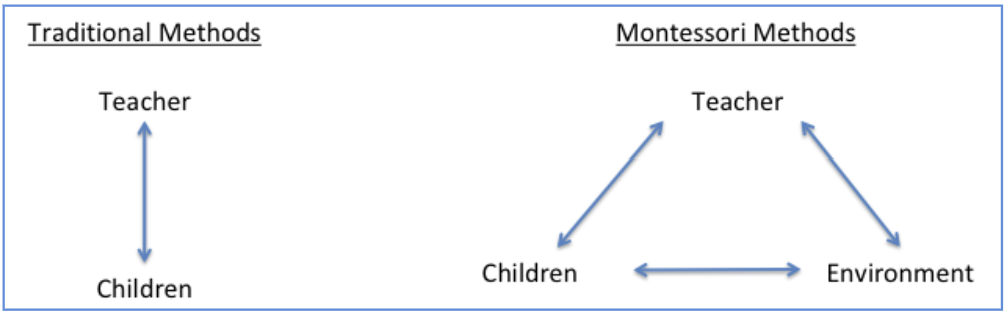
Montessori’s prepared environment steps away from the traditional classroom system where the children rely on the teacher for information and learning. In the Montessori environment, both the directress and child have a relationship with each other and the environment. By preparing and understanding the environment, the directress builds a relationship with the child in order for him to develop a relationship with the environment.
Tangible aspects of the environment
Space
There should be sufficient space to allow for a freedom of movement that support the tendencies and sensitive periods for movement. The place should also be beautiful, with light colours, pictures, places for reading, snacks/water, toilets, storage for belongings, quiet corners and replenishment of materials. To keep the children safe, the space should be open enough so that the teacher can always cast her eye across the various areas to see what the children are doing.
Simplicity
By customizing the materials and preparing developmentally specific activities, the child grows in independence and relies less on the adult.80 Any assistance rendered should be to help him use his own efforts. Anything that hinders or is irrelevant to his learning is eliminated.
Tangible Order
Order is important so that the child can finds things easily and knows where to replace them. This helps the child create an internal sense of order in relation to his environment. This order is extended to the directress’s presentation of the materials. This follows an order that resonates with the developmental order in the child.
Reality
To foster the child’s interests, the directress must also develop her own sense of intellectual curiosity towards general knowledge of the world, enabling her to expand the interests that call to the deepest tendencies of the child. While she “amuses” and “charms” them through stories, poems and songs, these are anchored in reality to support his tendencies for language, movement, creative imagination etc.
Beautiful and functional furniture
The environment should be attractive as beauty helps one to concentrate and at the same time refreshes the spirit. However, beauty alone is not sufficient and the furniture should be built in such a way that children are able to carry it. When the child knocks into them, the furniture moves out of place, providing feedback to the child to control and soften his movements. Additionally, fragile objects in the environment help children to correct their movements in order not to break them. This supports the sensitive period for coordination of movement and refinement of the senses
Child-sized
One of the main differences between the prepared environment and a home environment is that most home environments are adapted to the size of the adult and not to the child. In the Montessori environment, the size of the objects is suited to the child instead of the adult.
Mixed age group
Having a mixed age group allows the younger children to learn from the older ones and the older ones to role model for the younger ones. This provides opportunity for the children to participate socially as a community.85
Intangible aspects of the prepared environment
Respect
Respect is naturally shown in the prepared environment through opportunities for independence in learning, doing and being. With the ability to exercise choice, children are autonomous and their consent is always sought. With the respect that is modelled for him, the child learns to be respectful of his environment.
Independence and choice
Through understanding the child’s tendencies for independence, the child should take a more active approach in learning as compared to the directress. The role of the directress is to provide minimum input so that the child can be independent and autonomous when working. The more the directress recedes into the background, the more the child is empowered in his learning and requires less of her.87 This allows him to make his own choices and work as he pleases. By being free to work without self-consciousness, he has space to express his tendencies of exploration and curiosity. Hence, the directress needs to discern if assistance is required, and if at all, it should be carried out as a spontaneous gesture rather than “help”.
Praise
The directress is required to know the right balance of acknowledgement to be given to a child. Affirmation should not be used liberally so that the child comes to rely on it as motivation for doing an activity, however it there is none at all, the child may feel completely ignored. Hence, a minimum level of acknowledgement is required. If the child is deep in concentration, praise should never be given to interfere with the work of the child.
→ For the full article download this link
→ Back to Topics
Character Development
We live in a world today that is constantly in strife. Throughout human history, the pursuit for peace has remained elusive. Competition for resources, political, social and religious ideologies create divisions amongst groups of people. Instead of embracing diversity and working for the common good, humanity has moved in disparate ways, at times, resulting in violence. Montessori’s aim for education was to help mankind progress and seek peace by supporting the natural inclinations of the child. She believed that the child’s creative endeavours naturally lead towards harmonious relationships. By placing the child in an environment that supports his developmental instincts, the child will blossom into a socially aware being.
Traditional Expectations of Children
It is a commonly held belief that children should be boisterous, chaotic and inattentive.97 Children are experienced as energy draining because of the need to “control” and make them “behave”. Montessori believed that this was not the natural state of children, but that obstacles had been placed in the course of the child’s spontaneous development. If the environment that the child begins in his first three years of life prevents him from expressing his tendencies, the line of creative development is thwarted and he develops behaviour that does not help his growth.
Repressions
“Children are repressed when thy are prevented from doing those special activities that nature imposes on the human personality in order to grow well.”98 These repressions originate from two areas, the first being a lack of intellectual stimulation of the child and the second, the curtailing of movement in the child. Restraints in activity deny the child opportunity to move his mind and body. The tendencies for exploration and the coordination of movement are impeded, depriving the child from making discoveries that will help his physical and psychic development. As a result, his ability to develop language and linguistic abilities are also hampered. Fewer experiences bring less exposure to the language and a handicap in attaching meaning to the words he hears.
The repressions in the child are not always the result of poor intentions but more often a misguided sense of protection and safety for children who are perceived to be vulnerable and defenceless. Unfortunately, these frustrate the potential of the child and he manifests these repressions in alternate behaviours that pose challenges in his interactions with others and interferes with his own development.
These behavioural maladies are not caused by inherent moral defects in the child but in the lack of providing the right conditions for the child’s natural and instinctive developmental needs to flourish. Hence, the remedy is to create an environment that promotes his growth, physically and intellectually. When “The so-called bad qualities, together with the good and the superior, all vanish and there remains only one kind of child.” The arrival of such a transformation is what Montessori calls the “Normalized Child” and is where true education can begin.
Conditions for Normalization
In normalization, the physical and intellectual aspects of the child become integrated, and his will matures. This follows a process that is observed, to be a universal phenomenon across various disciplines where “… a piece of work done by the hands with real things, work accompanied by mental concentration.” An adult does not instruct this work but the child “…can choose what he will take and use.” Through freely chosen constructive activity, the child brings his entire being together and begins his work of organizing his personality.
Work
Activity that speaks to the child’s interests, tendencies and sensitive periods, provokes the child’s attention as it satisfies a deep developmental need. Through this spontaneous activity, the child gains mastery of himself and of the environment. In this experience, the child becomes conscious of his abilities and is inwardly empowered requiring neither external praise nor validation.
Real Things
Toys are a favourite item that many adults love to give children. However, their value does not sustain the interest of the child for long. Concentration and attention develops through his drive for self-perfection and is done “… through contact with reality, through activity that absorbs all his attention.”
Freely chosen
The child has liberty to follows his inner directives that direct him towards activity that best support his growth. This cannot be imposed by the adult’s directive but through the child’s own efforts and experiences.
Concentration
When the motivation for activity is so in line with the child’s interest that it provokes his deep attention, what is observed is “…a phenomena of real concentration and, once this happens, good will start coming out of this concentration..” His entire being is engaged, so that he works with exactness and repetition, giving him opportunity to coordinate his movement as he builds his intelligence. This concentration produces a real change in children unlike occupation, where the child’s attention is focused but flits from one activity to the next, not using objects for their proper intention.
Fruits of Normalization
In normalization, when the child applies true powers of concentration, he is able to bring himself to a love for order, work, spontaneous concentration, attachment to reality, love of silence and working alone, sublimation of the possessive instinct, power to act from choice and not curiosity, obedience, independence, initiative, self-discipline and joy. The behavioural difficulties experienced previously give way to character development in the child.
Perseverance
Through concentration, the child embarks on a process of repetition that is driven by his own inner guides. Working in tandem with the freedom to choose his own work, the child constructs his own predetermined plan and exercises his will to follow through from start to end. Therefore, it is imperative that the adult allows the child to follow his instincts in order to develop inner wisdom.
Possession of knowledge
With normalization, the child’s initial desire to possess objects transforms to a hunger for understanding how things in his environment function. Through this quest for knowledge, the child frees himself from possession and the object he desires, so that he may create distance to watch and admire how things works. Possession is sublimated into having a sense of wonder for the environment and leads him to care for it. The child’s encounters an inner revolution that moves from destruction to construction and protection.
Care and Love
“Once the child has felt the fascination of one object, he will become zealous in the conservation of all objects.” Normalization results in the desire for knowledge that leads to a new consciousness and understanding. Love is its consequence and inspires servitude in the child. This is nature’s way of developing the human spirit that forms the character of the child.
Therefore, for parents, we are invited to ask ourselves, “what developmental needs do I see in my child? How can I support it by providing the 1. right environment for these needs to be expressed 2. the right boundaries so that while there is freedom to express these needs, there are limits that keep the child, others and the environment safe?
→ For the full article, download this link.
→ Back toTopics
Normalization
In Montessori, normalization does not mean making children behave, conform, or become “good” in the conventional sense. It describes what happens when a child is able to be fully themselves.
When children are given “… a piece of work done by the hands with real things, work accompanied by mental concentration.” An adult does not instruct this work but the child “…can choose what he will take and use.” Through freely chosen constructive activity, the children brings their entire being together and begin their work of organizing their personality.
They become calmer, more focused, and quietly confident. They show joy in effort, care for their work, and consideration for others. These qualities are not taught or enforced. They emerge naturally when a child’s deeper needs for independence, order, and purposeful activity are met.
Normalization is not about acheiving obedience and compliance because an adult said so. It is achieving obedience and compliance because they know that what is asked of the adult is good for them and not because it serves the good, convenience or whims of the adult. They have experienced the benefits of the tasks and trust the adult’s intention.
With normalization, children will still experience frustration, excitement, and big feelings. What changes is that they develop an inner sense of organisation and self-regulation where these feelings can be managed and articulated.
For parents, Montessori invites a shift in perspective and a call for introspection. Instead of asking how to manage behaviour, we are invited to ask
“What are the unmet needs here?”
“What changes need to be made in our environment or the daily rhythm, to help my child feel grounded, capable, and at peace?”
“Is there something I am doing, which needs to change?”
Are we able to distinguish and discern, our needs from the child’s needs? So that when we make requests to the child we know it is to serve the child’s need and not to serve our convenience and whims? And when these needs are in conflict, how can we achieve a compromise?
When these conditions are present, positive behaviour follows as a natural outcome.
→ For the full article, download thislink.
→ Back to Topics